
Welcome!
Mika Waltari is one of the best known and well loved Finnish authors. His varied production covers
nearly all literare genres. His books have been widely translated and new translations are
regularly published up until this century.
In public votes Sinuhe egyptiläinen (The Egyptian) was chosen as The Most Beloved Finnish book of 2008 and The Book of the Century on the centennial of Finland’s independence in 2017.
For more information about Waltari see Panu Rajala’s introduction below.
The Mika Waltari Society
The Mika Waltari Society was founded in 2000 with the aim of introducing the life and production
of the author, gathering up information and promoting research and publishing activities.
The Society organizes lectures which are open to all. They are video recorded and can be viewed
afterwards on the society’s Youtube channel.
To its members the Society organizes visits to exhibitions and theatre performances as well as film
screenings.
Since 2004, the Society has published a biennial yearbook.
The Society also organizes trips abroad to places related to Waltari or his works. So far, the society
has visited, inter alia, France, Italy, Turkey, Egypt and Israel. In Finland we organize guided
walks in Waltari’s home town Helsinki and trips to other places related to the author, like his
summer residence.
Other traditional gatherings are the celebration of the author’s birthday on the 19th of September
and the Christmas party.
On special Waltari anniversaries, extraordinary programs such as seminars are organized.
The society has a Facebook page (in Finnish).
If you need more information or other assistance, please contact us:
Juha Salo, the President of the Society: juhasalo2(at)gmail.com
Sirkku Lindholm, Secretary of the Society: sihteeri[at]mikawaltariseura.fi
Mika Waltari 1908 – 1979 (written by Panu Rajala)
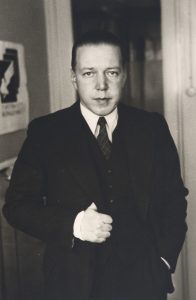

Mika Waltari, a Helsinki-born Finnish author studied theology, literature and philosophy at the University of Helsinki. He received the degree of Master of Arts in 1929 and became Member of the Finnish Academy in 1957.
Mika Waltari started his literary career in a cosmopolitan way by finishing his first novel Suuri illusioni (The Great Illusion) in Paris in 1928. Before that he had already published a religious story, a collection of mystery and horror stories as well as poems. His first novel was received with enthusiasm in Finland and widely regarded as a signal of a new era. Like other young poets of his generation in the postwar Finland, Waltari wanted to open windows towards continental Europe.
His first novel captured the immediacy of the zest for life set free, and the sentiments of a pleasurable tragedy in the 1920’s. His stylistic role models included Paul Morand, Ernest Hemingway and Scott Fitzgerald. With The Great Illusion Waltari introduced urban romanticism into Finnish literature where the mainstream thus far had been realistic depictions of rural life. In 1929, Waltari travelled for the first time to Istanbul which became an important city for his subsequent well-known novels Mikael Hakim (The Renegade, in US The Wanderer) and Johannes Angelos (The Dark Angel) in 1949 and 1952, respectively.
His travelogue Yksinäisen miehen juna (A Lonely Man’s Train) in 1929 was a farewell to the days of his youth and the freedom of the 20’s; the collapse of the New York Stock Exchange was a turning point before the Great Depression and political unrest. Waltari married Marjatta, the daughter of lieutenant-general Luukkonen, got a daughter Satu and devoted himself to a serious and exceptionally plentiful literary production.
In the 30’s Waltari worked as an editor for Suomen Kuvalehti, did translations for the publishing house WSOY, wrote over 600 book reviews for the newspaper Maaseudun Tulevaisuus, edited commissioned works, wrote a few film scripts and five plays as well as several novels and short stories. In that period, his main work was the trilogy Isästä poikaan (From Father to Son) in 1933-1935 portraying his own family and the city of Helsinki through three generations from the middle of the 19th century to the 1930’s. His native Helsinki played a central role also in his novel Surun ja ilon kaupunki (City of Distress and Joy) in 1936.
In 1937 Waltari won a novelette competition with his short novel Vieras mies tuli taloon (A Stranger Came to the Farm). For the first time Waltari had set the scene on the Finnish countryside. An intense tragedy founded on destiny with erotic turns and a violent ending led to an outburst of moral indignation among the readers. The writer accepted the criticism and wrote an appeasing sequel to this novel entitled Jälkinäytös (An Epilogue) in 1938. A Stranger Came to the Farm was first translated into Swedish, German, Norwegian, Danish and Estonian, then into Latvian, Dutch and Italian and later on into Romanian and French in 1944.
After The Great Illusion Waltari had already received some translation work in Scandinavia but now he had become a relatively well-known name in continental Europe, too. After Waltari’s success with his historical novels, A Stranger has been translated into 16 languages An Epilogue being often added in the same volume. Even though the novel is firmly rooted in the Finnish soil, the Lawrencean theme has appealed to readers across language barriers.
In 1939, Mika Waltari won the Finnish part in a Scandinavian detective story competition. His detective character inspector Palmu, a Finnish version of Hercule Poirot, became so popular that Waltari wrote two further books on his investigations in Helsinki. All have been filmed by director Matti Kassila and the humorous Palmu-films are nowadays evergreen favourites especially among young spectators. Detective stories were, however, only a pleasant hobby for Waltari.
When the Winter War broke out Waltari entered the service of the State Information Office. During the five years of the war he subordinated his productivity to the service of patriotic propaganda, fighting with his typewriter. He wrote countless articles, slogans and even complete books to the needs of psychological warfare. His novel Antero ei enää palaa (Antero Won’t Come Home Any More) in 1940 was translated into seven languages including Hungarian and Spanish. He also wrote two romantic novels on the history of Finland. His book Totuus Virosta, Latviasta ja Liettuasta (The Truth About Estonia, Latvia and Lithuania) in 1942 has later been praised by Jaan Kross, who wondered how a Finnish writer could know more of the Estonian tragedy than the Estonians knew themselves.
Ancient Egypt had fascinated Waltari ever since Tutankhamon’s tomb had been discovered in 1922. He had written juvenile poems, followed by a 1936 play about Pharaoh Akhnaton, shown at the Finnish National Theatre, and was already sketching a proper novel about Egypt but had no time to start before the war broke out. It was a lucky coincidence, however, as the war deepened his view and sharpened his outlook and enriched the novel which he wrote when the peace came in 1945. Sinuhe egyptiläinen (The Egyptian) was published in two volumes, a total of nearly 900 pages. This novel is clearly the greatest achievement in Waltari’s career. The fall of the European civilization with all its devastation and horrors were reflected in the events that had taken place 3 300 years ago. The fall of the new monotheist and pacifist religion and the ideology of Pharaoh Ekhnaton, the collapse of his empire in bloodshed and massacre, the marching forth and the conquests of Commander Horemheb’s troops vividly reminded about the upheavals of modern times.
The Egyptian was selected as The Book of the Month in the United States in August 1949 and rose to the best seller list. It stayed at top for several months and remained on the list for two years, sold 500 000 copies and received mostly glowing reviews. It was filmed in Hollywood Cinemascope style in 1954 but the film never did justice to Waltari’s rich novel. Sinuhe’s story has now been translated into 44 languages and is by far the most popular and best known Finnish novel ever written.
Waltari went on with historical subjects writing heavy volumes like Mikael Karvajalka (Michael the Finn, in US The Adventurer), The Sultan’s Renegade (in US The Wanderer) and The Dark Angel about the siege of Constantinople in 1453. Waltari was interested in the Islamic religion and the state of Turkey, which he visited three times. Intererestingly enough, he never went to Egypt although President Nasser invited him there after Sinuhe’s worldwide success.
Finally, Waltari turned to mysticism in Turms kuolematon (The Etruscan) in 1955 and returned to the beginning of Christianity in his last historical novels Valtakunnan salaisuus (The Secret of the Kingdom) and Ihmiskunnan viholliset (The Roman) in 1959 and 1964, respectively. In addition, he wrote several excellent novellas and short stories like Fine van Brooklyn and those in the collection The Tree of Dreams and Other Stories in 1965. He was an impressively productive author with more than 1 155 entries in his bibliography.
Mika Waltari died in 1979 at the age of 70 years.
Updated 29.10.2025